why tesseracts?
I’m not interested in tesseracts per-se, what I am interested in is ordered collections of binary digits (or binary strings) of length N.
For example, say we are interested binary strings of length 4. There are 16 such possible strings that range from all “on” to all “off” i.e.
    ----
    x---
    -x--
    --x-
    ---x
    x-x-
    -x-x
    xx--
    -xx-
    --xx
    x--x
    xxx-
    -xxx
    x-xx
    xx-x
    xxxx
This list can be represented as a 2-dimension orthographic projection, e.g.
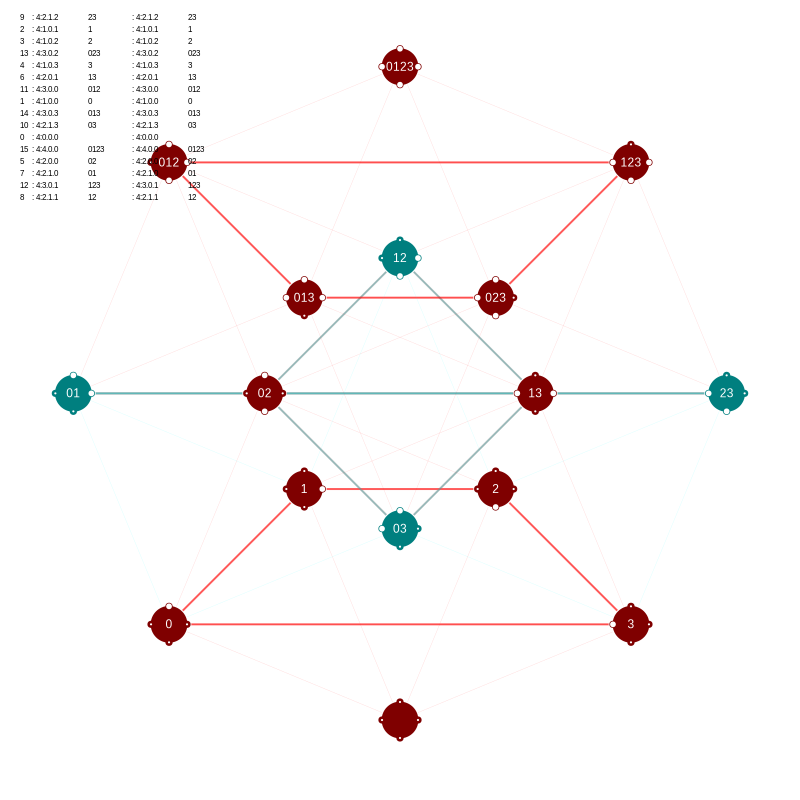
4-cube
I haven’t noted each binary string on each vertex, but I have noted the occupied points for each item, e.g. x-x- is denoted 03(counting from zero).
    ----
    x--- 0
    -x-- 1
    --x- 2
    ---x 3
    x-x- 02
    -x-x 13
    xx-- 01
    -xx- 12
    --xx 23
    x--x 03
    xxx- 012
    -xxx 123
    x-xx 023
    xx-x 013
    xxxx 0123
Ignore the colouring and the connections for now, just observe that all 16 items are present in the diagram, the “all off” vertex is at the bottom, the “all on” vertex is at the top.
Note also that you can effectively see the binary representation for each point represented as a ring with dots around it - a big white dot means “on”, a black dot (with tiny white centre) is an “off”.
The projection above is pretty typical, but I’ll be mostly using a slightly different projection that looks like this
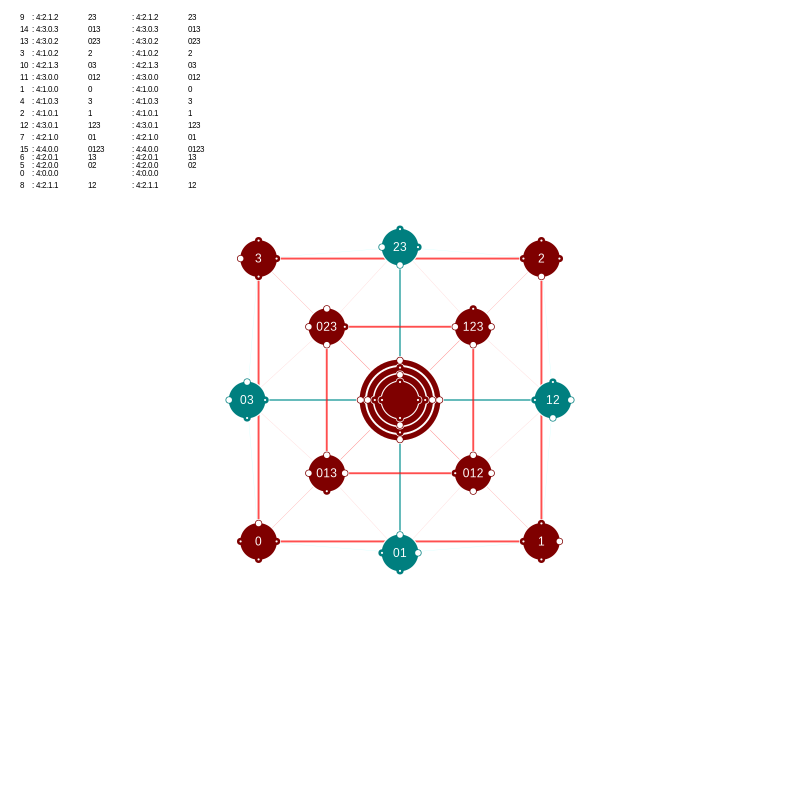
4-cube (wrapped projection)
This differs in that there appears to be less points that there should be. What is happening is that many of the points are lying on top of each other, i.e.
they are occluded. For example, the point labelled 012 is hiding another point 1, and the centre point labelled 0123 (all on), is hiding - (all off), 02 and 13.
I have tried to represent this occlusion by drawing the rings for each point in concentric circles so you can still read off each point.
That’s about it for a very brief introduction and all we’ve really seen is that you can draw a 2-D diagram for what is effectively an n-dimensional binary space.
Categorization and Notation
If we look at the 16 points we’ve got in a our list, we can categorize them with the following notation
l:n.r.d
where:
- l is the number of bits in the string (4 in our case)
- n is the number of “on” bits in the string (0 to 4 in our case)
- r is the “reference pattern id” (more on this later)
- d is the “duplicate id”, which distinguishes rotationally identical instances of each reference pattern
  no bits on
  ----    4:0.0.0

  one bit on - one reference pattern with 4 duplicates
  x---    4:1.0.0 - duplicate 0
  -x--    4:1.0.1 - duplicate 1
  --x-    4:1.0.2 - duplicate 2
  ---x    4:1.0.3 - duplicate 3

  two bits on - reference pattern "0" with only two duplicates
  x-x-    4:2.0.0 - duplicate 0
  -x-x    4:2.0.1 - duplicate 1

  two bits on - reference pattern "1" with 4 duplicates
  xx--    4:2.1.0 - duplicate 0
  -xx-    4:2.1.1 - duplicate 1
  --xx    4:2.1.2 - duplicate 2
  x--x    4:2.1.3 - duplicate 3

  three bits on - only one reference pattern
  xxx-    4:3.0.0 - duplicate 0
  -xxx    4:3.0.1 - duplicate 1
  x-xx    4:3.0.2 - duplicate 2
  xx-x    4:3.0.3 - duplicate 3

  all bits on
  xxxx    4:4.0.0
Notes
- Tesseracts, or hyper-cubes or n-cubes are described by wikipedia (http://en.wikipedia.org/wiki/Tesseract) in some detail.